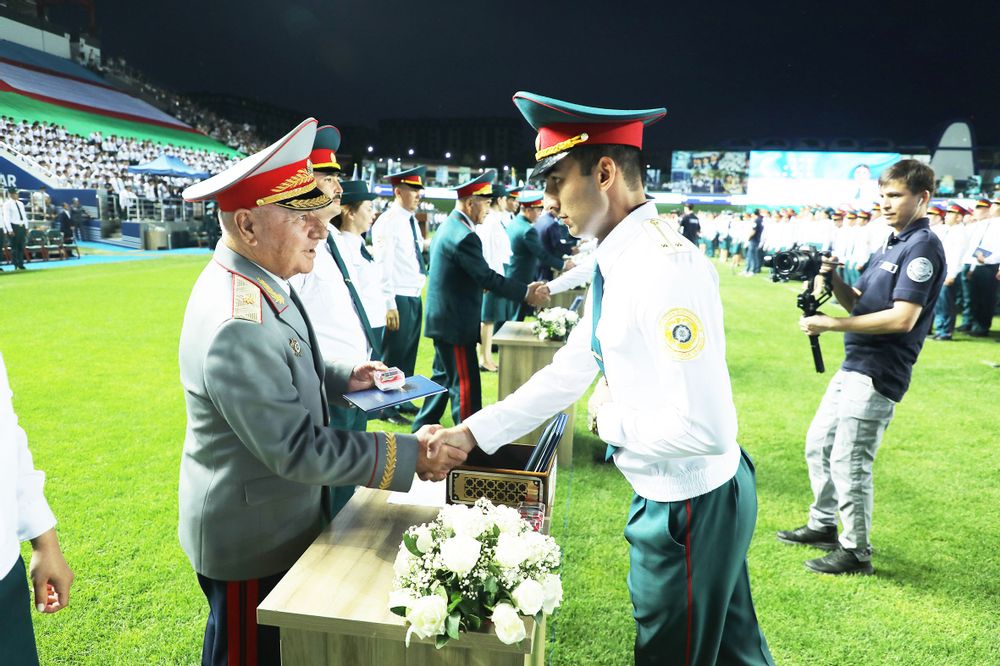
“In 1969, after returning from compulsory military service in Russia’s Kirov region, I went to the defence office to register,” says the subject of our article. “I struck up a conversation with a captain in the corridor. I was still in a military frame of mind and wearing my soldier’s uniform. He looked at me closely and asked, ‘Would you like to work with us?’ He explained that the service was recruiting. To be honest, my former job as a mechanic at the Tashkent Hydroelectric Power Station was waiting for me because my position had been kept open while I served. But I admired the resolve in the captain’s face and words, and I decided on the spot to submit my documents.”
That unexpected offer brought me into the internal affairs system. Over more than thirty years, I rose from an ordinary officer to senior leadership positions and eventually retired with honour.
Throughout his career, retired Major General Erkin Norgitov devoted all his knowledge and energy to his work. He served in such responsible posts as Head of the Tashkent City Police Fire Protection Directorate, Deputy Minister of Internal Affairs, Head of the Namangan Regional Police Department, Head of the Tashkent City Police Department, and Deputy Head of the Academy of the Ministry of Internal Affairs. His dedication, thoughtful judgment, and distinctive approach to work earned the respect of both colleagues and senior officials.
In the early years of Uzbekistan’s independence, the situation in Namangan was particularly difficult. When Erkin Norgitov was appointed head of the regional police department in 1993, religious extremist groups had begun to emerge. Fanatics tried to turn people against the authorities and disrupt public peace. Norgitov did not lose his composure in this dangerous situation. He quickly brought matters under control, studied weaknesses in the system, and focused on strengthening material and technical resources and improving staff capacity. The decisive measures significantly reduced crime and improved detection rates. Juvenile crime, in particular, fell sharply.
His dedicated service received due recognition. By a decree of the First President of the Republic of Uzbekistan dated 13 March 1994, Erkin Norgitov was awarded the rank of Major General.
“Interest or desire alone is not enough to choose a field as demanding as internal affairs,” says retired Major General Erkin Norgitov. “An officer spends most of his time among the people. He must therefore know how to communicate with the wider public and listen to them. Throughout my long career, I did my best to remain close to people and understand their concerns. Looking back at the path I have travelled, I now feel a deep sense of fulfilment.”
When a person is generous in spirit and pure in intention, goodness takes root along life’s path. The subject of our article was also a caring father and a dependable pillar of his family. Together with his late wife, Hamida, he raised one son and two daughters to become worthy members of society. Their only son, Shuhrat Norgitov, followed in his father’s footsteps, served successfully in the internal affairs system, and retired with the rank of Colonel. Their daughters, Muhabbat and Dilobarkhon, chose teaching and devoted their lives to educating the younger generation.
Retired Major General Erkin Norgitov, Chairman of the Council of Veterans of the Ministry of Internal Affairs, will soon celebrate his venerable eightieth birthday. This is more than a number or a line marking eight decades. It is the story of a meaningful life in which every day has been devoted to the progress of the homeland and to the peaceful, prosperous lives of its people.
Even today, he continues the honourable work of passing his high human qualities, rich experience, and heartfelt devotion on to his students and the younger generation. At the summit of eighty years of wisdom, he still works with the energy of the twenty-year-old soldier he once was and with the same love for his homeland. His life remains a living example of devotion to duty for present and future generations.
Gulnoza TURG‘UNBOYEVA,
staff correspondent.