Security is no longer just at the border
In today's world, the scope of the concept of security has expanded considerably. While it used to be primarily associated with borders, the military, and weapons, it now includes economic stability, food and energy supplies, information space, cyber security, public order, youth education, and legal culture.
According to the Stockholm International Peace Research Institute (SIPRI), in 2025 world military spending will reach 2 trillion 887 billion US dollars. This is a sign of increasing armaments and international mistrust.
Stability guarantee
Defense of the Motherland is a constitutional obligation in Uzbekistan. Our basic law states that it is the duty of every citizen to protect the country. At the moment, the principle of "adequate Armed Forces" shows that our security policy is aimed at reliable self-defense, not aggression.
In recent years, the legal framework for security has expanded significantly. The "Uzbekistan - 2030" strategy, the update of the military regulations of the Armed Forces, the adoption of new laws on cyber security and state secrets confirm that security is no longer limited to military laws, but also includes cyberspace, information and civil responsibilities.
Region and foreign policy
The security of Uzbekistan cannot be separated from the general stability of the Central Asian region. The issues of water and energy, transport, trade, migration concern the entire region. Therefore, strengthening mutual trust and good neighborliness with neighboring countries is a priority of our foreign policy. The Consultative meeting of the leaders of the Central Asian countries held in Tashkent in 2025 and the proposal to turn it into the strategic format of the "Central Asian Community" started a new stage of regional cooperation.
In foreign policy, our country has chosen a multi-vector path based on national interest rather than unilateral dependence. Strategic partnership with Russia, large-scale cooperation with China, "C5+1" format with the USA, expanded partnership with the European Union - all these are built on the basis of balance. And this is an effective means of ensuring security not by military means, but by diplomacy, economic interest and trust.
The most important task
The state's resistance to external threats depends primarily on its internal stability. Internal stability is ensured not only by the activity of power structures, but also by fair laws, social protection, education, neighborhood institutions, healthy family environment and legal culture.
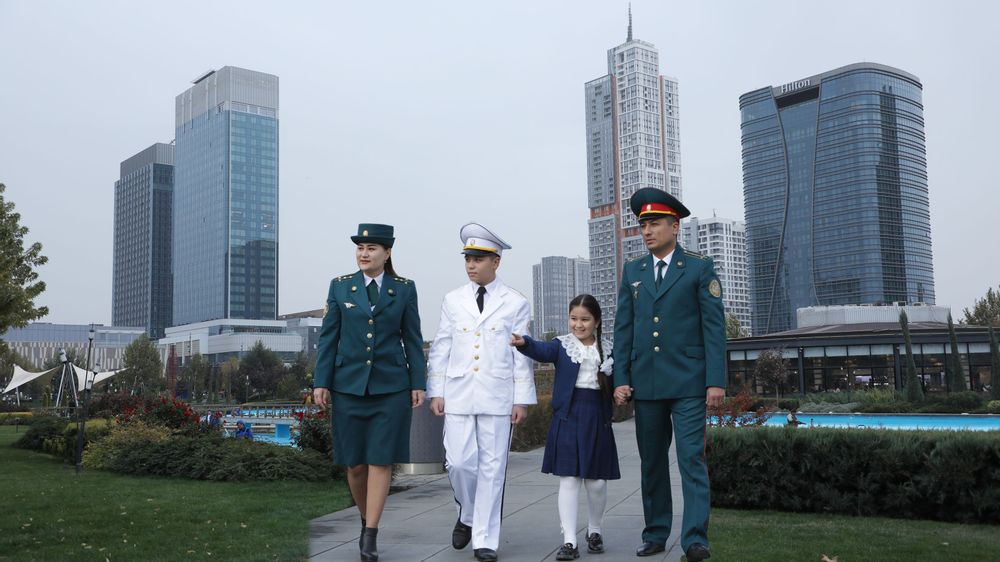
At this point, the role of the internal affairs bodies is of particular importance. Maintaining public order, prevention of crimes, prevention of extremism and radicalization, fight against cybercrime, improvement of legal culture of citizens - all these are the internal social foundations of national security. In this sense, internal affairs bodies are an important socio-legal link of the national security system.
Contributing to security in the information age is in the hands of every citizen. Not believing fake news, verifying information, observing cyber hygiene, respecting public order, not being indifferent to breaking the law, being responsible for raising children - each of these is a contribution to the security of the Homeland. Especially educating young people to be educated, professional, legally aware and patriotic is one of the most important tasks of today.
Shared responsibility model
Based on the above, national security can be imagined as a "distributed responsibility model". In it, the army is a military shield, the law is a legal support, diplomacy is an external ring, a stable economy is a material ground, information culture is a digital protection, and patriotism and legal awareness are the spiritual pillars. If one of these layers is weakened, a gap appears in the entire system: if the information space remains vulnerable despite a strong military, or if the economy grows and the legal culture lags behind, the threat grows from within. Therefore, each field must complement the other.
In conclusion, the idea that "Peace and security of the Motherland is our common responsibility" can be expressed by the following formula:
strong army - protective shield;
just law - a guarantee of stability;
active diplomacy is a means of reducing external risks;
responsible society is the basis of internal stability;
A patriotic citizen is the basis of national security.
It is this harmony that will ensure a peaceful, stable and safe future of New Uzbekistan.
Muhiddin UMAROV,
MIA Military Academy
head of the preparatory department,
doctor of philosophy in military sciences
(PhD), professor, colonel.