
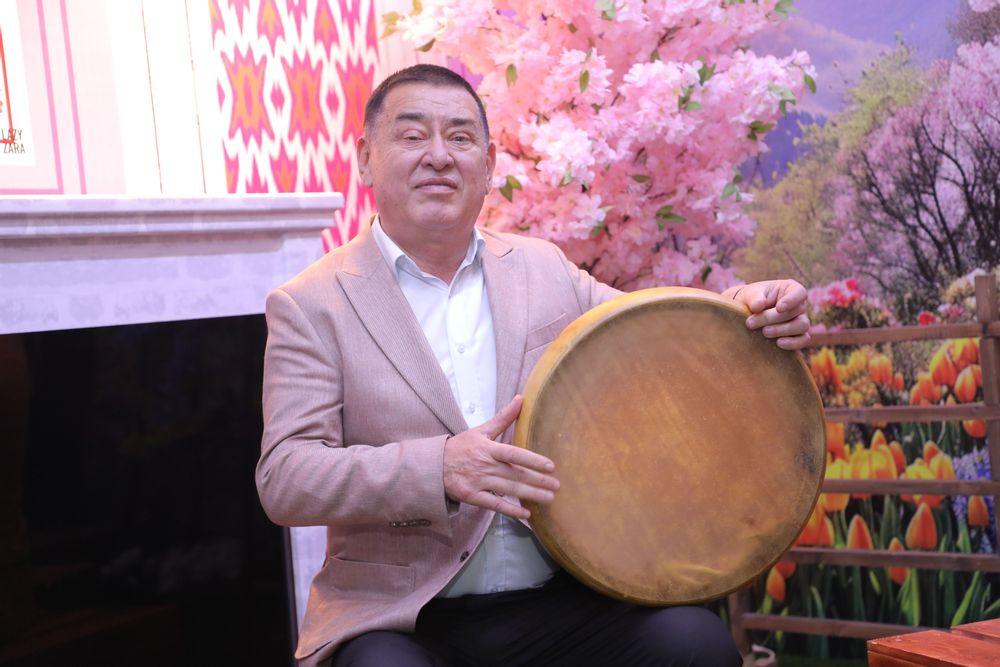
Honored artists of Uzbekistan - Dilmurod, Elmurod and Kholmurod Islamov have earned the respect and love of the people as artists who dedicated their lives to this magical sound of the circle. Today's interlocutor is Elmurod Islamov, a recipient of the "Dostlik" and "Labour Glory" orders, an artist who has served Uzbekistan, and the leader of the "Bek" national orchestra group of the Uzbekistan State Philharmonic.
- Brother Elmurad, let's start the conversation with your childhood memories...
- Our childhood yard was located in the "Workers' town" of our capital. I lost my father early. After their death, the responsibility of the family falls on the shoulders of my mother. It was not easy to raise five girls and three boys alone on the salary of an ordinary cleaner. There were many times when my brothers, sisters and I all went together to help with the cleaning work, seeing that my mother was suffering.
In our childhood, we saw both hunger and poverty. My sisters say that I went up to the roof and shouted: "I will eat bread, no-on." They were embarrassed so that the neighbors wouldn't hear.
I studied at the 20th school in Shaikhontohur district. In those days, children from low-income families were given clothes from school. I was also on that list. I wanted to take it, but I couldn't...
- How did you develop your love for art?
- There were many circle artists and famous artists in our neighborhood. My dear brother Dilmurod was the first to develop interest and love for drumming. However, there was neither money nor conditions to buy a circle. And my brother begged my mother to bring him a circle every day.
Our house consisted of two rooms. In one corner of the yard there was another small house with one room, which my mother rented out. The tenant paid 15 soums per month. One day, my mother, who could not tolerate my brother Dilmurod's crying, brought a circle for 11 soums, and kept the remaining 4 soums for a month's living.
The day we received the circle was a real celebration in our house. My brother Dilmurod felt sorry for him. My brother Kholmurod and I used to dance in front of him. In this way, the three brothers turned into a circle.
- If we also remember your teachers...
- I became an apprentice of Toychi Inoghomov at the age of seven. Later, I took lessons from many teachers such as Gofur Azimov, Anvar Ahrorov. Thanks to their education and upbringing, I have reached today's level. As fate would have it, when Toychi Inoghomov retired, I became the head of the circle.
The first lessons were given by my grateful brother Dilmurod Islamov. It was my brother who took me to the club. I am forever grateful to that person. My brother Dilmurod was the chairman of the "Uzbekistan Circlers" public association, the founder of the "Zarb" pageant and Circlers' Festival. He is also known as the author of a number of scientific and methodological manuals and articles.
- Playing a circle must also have its own secrets and difficulties?
- Of course, you can't just click on the circle, you have to feel it. Each beat should come from the heart, be combined with strength and pleasure. Unfortunately, today there are also ordinary shinavandas who do not feel the true effect of the circle. When I was younger, I used to practice for hours. I used to play a long circle, and my fingers would crack and become numb. But if the love for art is strong, a person will not feel these pains. When the fingers warmed up, the pain was forgotten. If I had to take a break and play again, the pain would start again. The viewer does not notice it, and the artist matures in these difficulties, his will is strengthened.
- We also hear a lot about the famous circle, which is always out of your hands and has been with you for years.
- This circle is not an ordinary musical instrument for me, it is like a precious monument that keeps the spirit of my whole life, memories and teachers. Its history is over a hundred years old. This circle was given to me by my teacher Dadakhoja Sottikhojayev. He worked in the maqam ensemble all his life. It is said that many people asked my teacher for this circle, but he preferred to give it to me only. Interestingly, after receiving the circle, I was awarded the title "Honored Artist of Uzbekistan" at the age of 27.
I have tried this range a lot. His voice is immediately recognizable among dozens of circles.There is some secret, magic in its navo.
- One of your lucky turns in the path of art was connected with the "Bahor" ensemble. Tell us about your memories of that time?
- In 1976, when I was still 16 years old, I joined the Uzbekistan State Philharmonic. Not long after that, in 1977, I was invited to the "Bahor" ensemble. Sister Mukarrama herself hired me. After that, we started going on creative trips to foreign countries. In those times, each trip was a big school and a big life lesson for us. It was a great responsibility for us to present Uzbek art on foreign stages, to introduce the culture and national melodies of our people to the world.
When I was 18, three Islamov brothers were laureates of the World Youth Festival. It was a great achievement not only for our family, but also for Uzbek art. At that time, the sounds of the national circle on the international stage, the admiration and applause of the foreign audience gave us unlimited strength and inspiration. Then I deeply understood one thing - art has no language and no nationality. Sincere performances and heartfelt melodies are understood anywhere in the world.
- Many describe you as a strict teacher...
- I won't deny it, but strictness is only during rehearsals and lessons. Outside of work, we have a cordial relationship with my students, like brothers. Because art requires discipline. I have educated more than three thousand students, among them there are students from neighboring countries.
- Today, there are various opinions about the growing influence of Western music on our national music and culture. How do you feel about this process?
- National music, it is impossible to deviate from the Uzbek path, because any art first of all relies on its roots. Art that is cut off from its roots is still weak. Some also use western musical instruments a lot. The three Islamov brothers performed on different instruments in Azerbaijani, Indian, Turkish and other styles. It was mostly in the framework of friendship programs and creative performances. But we would still start the concert with the circle sound and end it with that.
- What is your attitude towards the activities of the internal affairs bodies?
- I respect the representatives of this field. Because they are the people responsible for the order and peace of the society. Any driver with a full license and a seatbelt on is naturally a bit nervous when pulled over by a traffic officer. I think this is one of the virtues and responsibilities of this profession. I wish that every employee will be loyal to his duty and will be respected by our people.
- This year marks the 35th anniversary of our independence. How do you feel on the eve of the holiday?
- I will never forget the time when I was on tour in African countries in 1984. One day I went out from the hotel. All of a sudden, the sound of gunshots was heard, and everyone was confused. A shopkeeper immediately pulled me inside and hid me under the counter. My heart was filled with fear. In those moments, I realized that there is no greater blessing than peace for a person, I felt how sacred the concept of Motherland is. It is necessary to appreciate the peaceful country and peaceful days. God, may our homeland be peaceful and our sky always clear!
- Thank you for your meaningful conversation.
Adolat Fayziyeva spoke.
Photo taken by Abu KENJAYeV.