
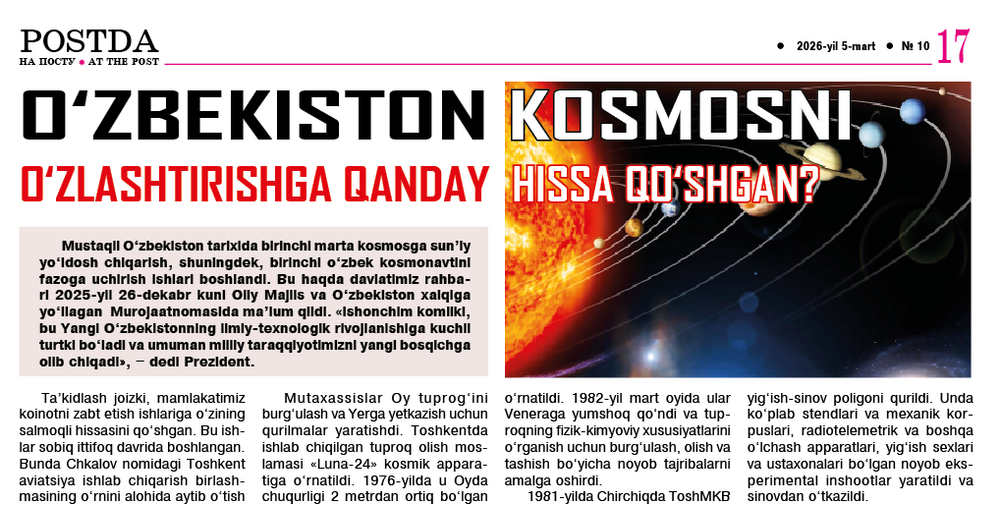
It should be noted that our country made a significant contribution to the conquest of space. These works started during the former union. It is necessary to mention the role of the Tashkent Aviation Production Association named after Chkalov. From 1977 to 1987, several "IL-76 MDK" aircraft-laboratories were built at the plant to test cosmonauts in weightlessness. More than a hundred Soviet and foreign cosmonauts were trained on these planes.
In 1969, the Tashkent Engineering Design Bureau (ToshMKB) was established. The Bureau developed tools and equipment to explore the Moon and Venus, design, manufacture, test space equipment, including antennas up to 30 meters in diameter, and collect and operate full-size state samples. The bureau was tasked with designing lunar bases, creating devices for extracting oxygen and water from lunar soil rocks.
Specialists have created devices to drill lunar soil and deliver it to Earth. The soil extraction device developed in Tashkent was installed on the Luna-24 spacecraft. In 1976, he drilled a well on the Moon more than 2 meters deep. The obtained soil samples were delivered to Earth for study. As a result of the analysis, for the first time, reliable evidence of the presence of water on the Moon was obtained.
ToshMKB was also involved in the creation of devices for the production of new composite materials in space. With the help of special melting furnaces and unique devices developed in Tashkent, experiments were conducted on melting various materials and taking samples from them in orbital stations.
Bureau specialists have developed a drilling machine that can work in an environment of extremely high temperature and strong chemical influence. The device was installed on automatic space stations "Venera-13" and "Venera-14". In March 1982, they soft-landed on Venus and performed unique drilling, retrieval, and transport experiments to study the physicochemical properties of the soil.
In 1981, a branch of ToshMKB - Kompozit experimental plant was established in Chirchik. Unique parts and components for space structures are made of composite materials. The plant produced composite glass and carbon fiber and products made from them. Carbon fiber is a lightweight yet strong steel-like material that has been used in aerospace, military, and automotive applications. Today it is widely used in everyday life.
In 1988, the Tashkent Research Institute of Space Instrumentation was established as a branch of one of the Moscow Space Centers. One of the directions of the institute was the processing of space images of the territory of Uzbekistan to identify natural resources and analyze economic and ecological activities, to study the condition of agricultural crops.
The scientific research institute has achieved valuable results in the fields of agriculture, construction, cartography, geology, geophysics, water and mineral resources. The institute has trained more than 50 specialists in the field of remote sensing of the Earth.
In the early 1980s, the ToshMKB collection and testing ground named after Nevich was built in the Parkent district of the Tashkent region for the programs "Oy" and "Energiya", "Buran". In it, unique experimental structures with numerous stands and mechanical housings, radiotelemetric and other measuring devices, assembly shops and workshops were created and tested.
In 1982, the construction of a radio astronomical observatory began on the Suffa Plateau in the Zomin District of Jizzakh Region. Its main object is a 70-meter radio telescope.
it was considered a unique tool for recording cosmic radiation in the millimeter range. Similar equipment is available only in San Diego, USA.
It is also worth noting the "Physics-Sun" scientific-production association of the Academy of Sciences of Uzbekistan located in the Parkent district of the Tashkent region. High temperature resistance tests of the protective coating of the "Buran" orbital ship were conducted in a large solar furnace. These studies are a significant contribution to space research of our country.
"Uzbekkosmos" agency was established in the first years of Uzbekistan's independence.Contacts have been established with national space organizations of foreign countries, in particular with the United Nations Office for Outer Space Affairs (UNOOSA). In 2002, the activity of "Uzbekkosmos" was terminated. The Space Research Center of the Academy of Sciences was established, two enterprises were included in it, and the rest were transferred to various ministries and agencies.
On August 30, 2019, the President of Uzbekistan signed a decree on the development of space activities in Uzbekistan. According to the decree, the agency "Uzbekkosmos" was established. The tasks of the agency include the creation of a system of remote sensing of the Earth and a network of satellite communication, the use of satellite navigation complexes, etc.
The implementation of these tasks allows creating modern jobs, developing science, ensuring the technological independence of the country in the field of space research, information security, and increasing the international prestige of Uzbekistan.
Prepared by Ghairatulla SHUKUROV.