
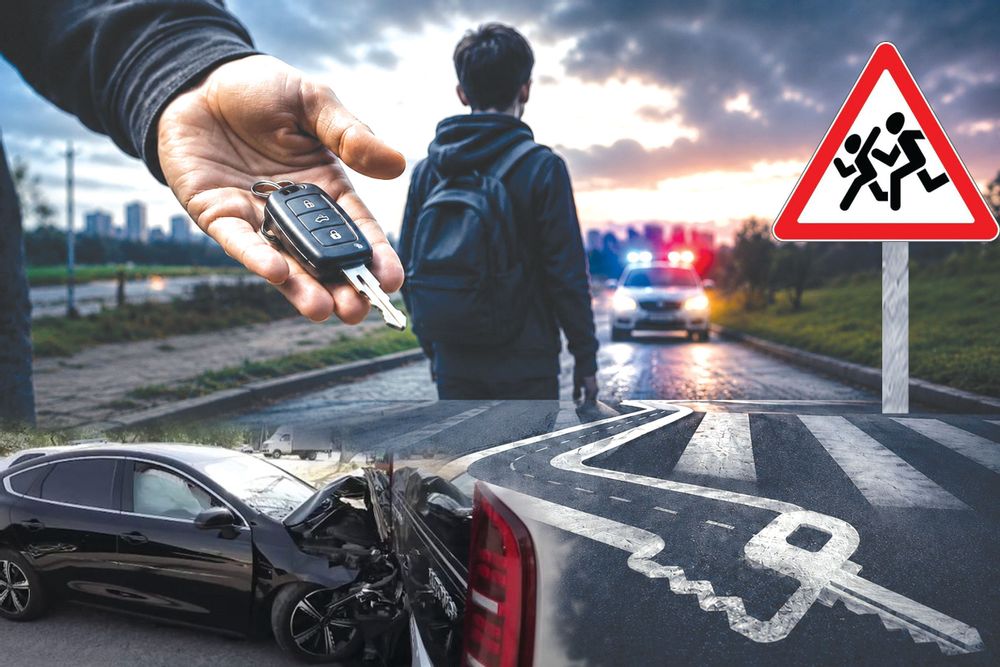
In recent months, several traffic accidents that shocked the public in Uzbekistan revealed a common aspect: the drivers were minors.
The dangerous aspect of the problem is that many people associate the issue of driver's license only with the document. However, a driver's license is not just a permit. To get it, a person must reach a certain age, master theoretical knowledge, acquire practical skills and pass an exam. These requirements are not a bureaucratic procedure, but a mechanism to protect human life.
Driving a vehicle is not something that can only be done by someone who knows how to drive a car. The ability to make split-second decisions, assess risk, and act appropriately in an emergency is also required on the road. Experts say that such skills are stable in a person after a certain age and experience.
From this point of view, the driving of a minor is not only a legal, but also a serious psychological and safety problem. Adolescents are often unable to assess risk in the same way as adults. He may not feel the consequences of speed enough, overestimate his capabilities, or make decisions under the influence of passion.
Today, social networks also influence this process. Videos of minors driving or speeding have been circulating from time to time. The problem is that some young people perceive such actions as a sign of bravery or prestige rather than a crime. This can serve to promote dangerous behavior.
It is not for nothing that the President raised this issue separately. At the presentation held on June 11, it was emphasized the need to strengthen the responsibility for those who allow minors to drive a vehicle. There is an important logic behind this approach: it is more effective to deal with the causes of a tragedy than to deal with its consequences after it has occurred. Because a teenager behind the wheel is often the last link in the problem. And before that, there are decisions of adults who gave the car keys, turned a blind eye to such an act or did not perceive it as a danger.
Another serious incident happened in the city of Tashkent. According to the information of the General Prosecutor's Office and internal affairs bodies, a teenager born in 2010 drove a BMW car without permission and hit a YPX inspector on duty. Despite the efforts of doctors for three days, the inspector died. In the investigation materials, it was noted that this minor had previously attracted the attention of law enforcement agencies with his dangerous actions.
The tragedy that happened in Ko'kan in May was widely discussed as one of these cases. According to the information of the Ministry of Internal Affairs, a schoolboy drove a Malibu-2 car and hit three girls who were crossing the sidewalk. As a result, one of them died in the hospital, two remained in a serious condition. It was determined that the teenager at the wheel did not have a driving license.
These two incidents took place in different areas and under different circumstances, but they have one important thing in common: the steering wheel was driven by a minor who did not have the right to drive.
Representatives of the traffic safety service have been emphasizing that in recent years, cases of driving vehicles by teenagers have become more frequent. In particular, showing cars on social networks, interest in speed and taking dangerous actions as a sign of "reputation" is becoming an alarming trend among some young people.
The most difficult part of the problem is that in such cases, the danger is not only for the teenager at the wheel, but also for complete strangers. Neither the girl who died in Kok, nor the YPX employee who died in Tashkent was driving the vehicle, but such irresponsibility of another person affected their fate.
From this point of view, it's not just teenagers driving. The main question is elsewhere: How does a minor get a car key?Why don't adults anticipate or take this risk seriously?
These questions are not in vain, because the head of our state, in a presentation held on June 11, emphasized that cases of allowing minors to drive a vehicle cause serious consequences, and noted the need to strengthen responsibility in this regard. So, the problem is getting out of the level of individual events and becoming an issue at the level of state policy.
Now the main question in the center of discussion is: is the teenager sitting behind the wheel more dangerous, or is it the carelessness of the adults who gave him the car keys?
In most cases, it is no accident that a minor drives a car. Behind it lies a decision made by an adult or a carelessness committed by an adult. That is why it is not enough to explain the problem only by the behavior of teenagers.
In practice, such situations appear in different ways. Some parents consider it a positive thing to start teaching their child to drive at an early age. Sometimes this experiment, which started in a closed area or on a village street, later spread to public roads. In other cases, adults themselves allow their minor child to temporarily drive the vehicle. As a result, an act prohibited by law begins to be taken for granted.
At this point, another important question arises: is increasing responsibility enough to solve the problem? Or is it necessary to take a different approach to the social environment, education and safety culture that causes minors to drive?
Strengthening accountability is important, but experience shows that any legal action can affect the effect of the problem, not the cause. An even more troubling issue emerges when looking at underage driving: a culture of misjudgment of risk.
Many parents are proud of their child's ability to drive. In some cases, it even becomes a topic of boasting. However, this is a risk, not a skill, because a car is not a toy. It is a high-risk source that can kill a person in a matter of seconds. The age limit for the right to drive is also not set by chance. This demand is based on years of international experience, research on road safety and scientific conclusions about human psychology.
Experts note that brain activity responsible for risk assessment and decision-making in adolescents differs from that of adults. Because of this, they tend to take more risks, and may not consider the possible consequences sufficiently. In driving a car, a few seconds of carelessness is crucial.
From this point of view, underage driving is not only a crime. This is a sign that several links in the security system have failed at the same time. First of all, family control will not work. Then the people around will not react to it. In some cases, the public does not perceive it as a serious risk.
In fact, community attitudes can be a more powerful prevention tool than law. If underage driving is viewed as irresponsible rather than skillful, these cases may be reduced. Today, in some cases, the opposite is observed - videos of teenagers behind the wheel are distributed on social networks, they are discussed, and some of them are met with interest and even envy.
That is why it is not enough to look at the problem only from a legal point of view. This issue is directly related to education, social responsibility and safety culture. The law punishes, but does not create a sense of awareness of danger. This task is primarily the responsibility of the family, educational institutions and society.
The tragedies that shook the country in recent months showed this fact: a minor at the wheel is not the cause, but the result of the problem. The main question is not who was driving the car, but why he was given this opportunity.
In each case, the hand that gave the key may be the same, but behind the decision that gave access to that key lies the responsibility of the adults. When it comes to road safety, awareness of this responsibility is crucial in preventing future tragedies.
Muslim INTELLIGENCE,
a journalist.